How Fair and Square was made
It looks simple. It took seven versions, hundreds of experiments, and a few months of my life.
-
June–July 2026 · Version 1
Merit or Math?
On June 12, Forbes reported that Elon Musk had become the world's first trillionaire. A question occurred to me: Is it merit, or math?
I had been thinking about Michael Sandel's The Tyranny of Merit. How much of success is deserved? How much is luck? And how much comes from the rules of the game?
Amazon Associate: I earn from qualifying purchases through the book links on this page.
Merit or Math? became the first title of this project.
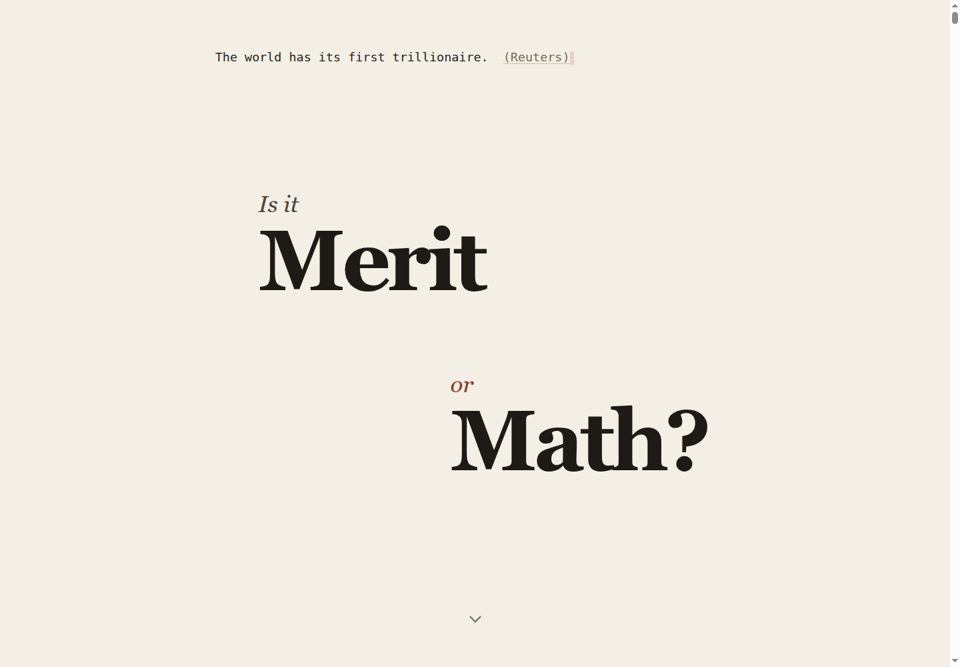
The July essay. Before there was a game, there was a question. Open any historical screenshot to see the full original. Then I came across the Yard-Sale model. It is astonishingly simple: people trade, the stake is limited by the poorer person's wealth, and a fair coin decides who wins. Repeated trades can concentrate wealth in very few hands. Add a wealth tax and redistribution, and the behaviour can change dramatically.
Nobody has to cheat.
I thought: The world needs to see this. A good intuition about a mathematical model can sometimes teach you more than a whole library of economics and philosophy books. I wanted to make that intuition visible.
From an essay to a little world
I began writing. Then I remembered why I became a physicist. I have a thing for simple rules that produce unexpectedly complex behaviour.
In 2006, with Ginestra Bianconi and Matteo Marsili, I published Scale-free networks with an exponent less than two in Physical Review E. We studied a simple model producing networks with exceptionally broad degree distributions, with an exponent γ smaller than 2. The free arXiv version is still there.
Different subject, same fascination: simple microscopic rules, surprising collective consequences. Why explain this model in a long essay when I could build a little world in which people could watch it happen?
- Kept: the question and the mathematics.
- Let go: most of the essay.
-
July · Version 2
A room full of shapes
There is an old joke about a physicist who approaches a problem involving a cow by assuming the cow is spherical.
My first agents were circles. One number, the radius, determines the shape. Area could represent wealth. Add eyes and a mouth, and it begins to resemble a person.
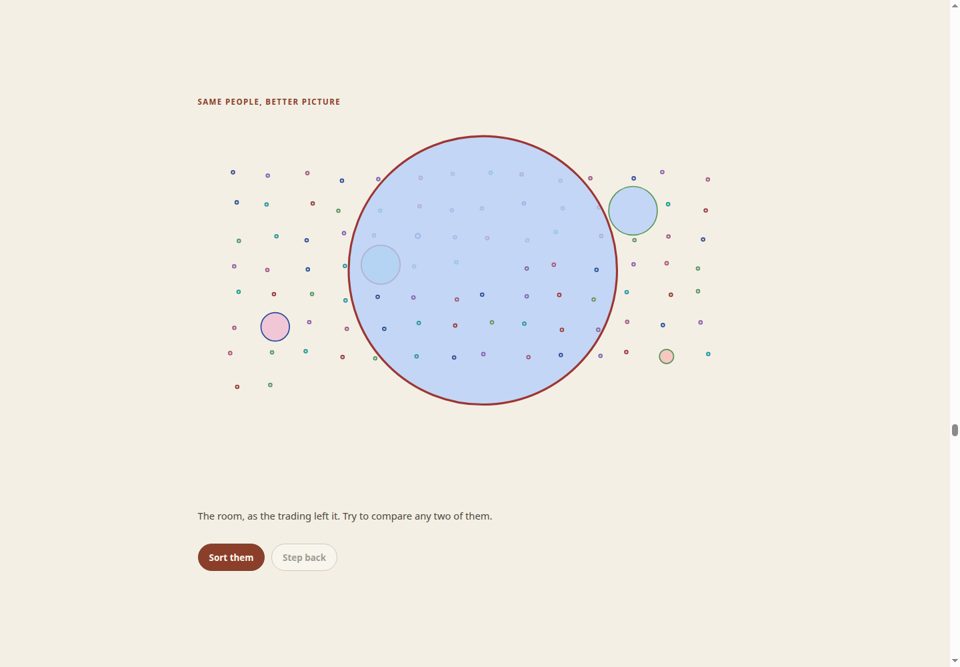
An early room of circles. Triangles, squares, hexagons, and other neighbours followed. I wanted diversity. But I also wanted to play with our habit of explaining success after seeing who succeeds. Perhaps the triangle became rich because it pointed upward. Perhaps the circle lost because it rolled too much.
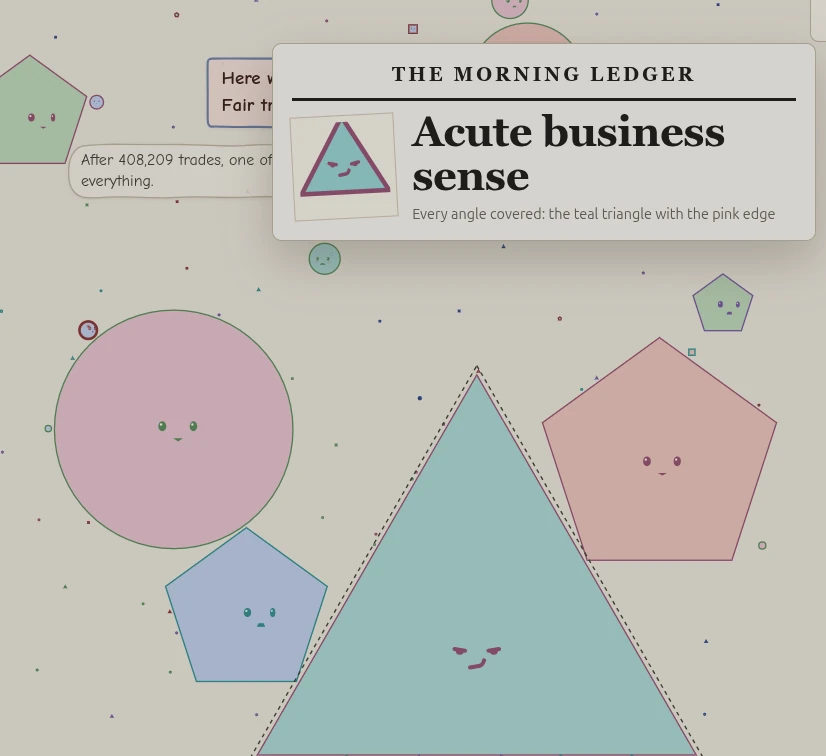
“Acute business sense.” The prototype's newspaper had an explanation ready. We are remarkably good at inventing explanations for outcomes that might have been mostly luck.
But I had a practical problem. Histograms, Lorenz curves, and other statistical pictures didn't emerge naturally from these shapes. I had to draw separate charts.
And then something clicked.
The discovery Let the squares become the charts
What if every agent were a square?
If a square's area represents wealth, its side represents the square root of wealth. But I can change the representation so its side represents wealth. Then its area represents wealth squared.
Wealth as area: each square occupies its share of the total coloured area. They keep trading as the packed arrangement changes. That small change made several statistical measures suddenly intuitive. For wealth shares si, the effective number of participants is:
Neff = 1 / ∑si2
Make each square's side its wealth share. The total area of the squares is the denominator. Now the question becomes: how many such piles add up to the area of a unit box?
The actual Learn sequence. Here the shares are nonnegative and add up to one, with no money in the pot. The same squares could become stairs for the Lorenz curve. A cumulative distribution could become a physical transformation. The complementary cumulative distribution turned out to be more natural to construct than a conventional histogram.
Into stairs. The Lorenz curve and the Gini emerge from the rearrangement. Into a distribution. The bars use a logarithmic money scale; a line counts who has at least that much. The charts weren't pictures about the agents anymore. The agents themselves became the charts.
Each chart became a group photo: the same squares, striking a different pose.
I think this was my favourite discovery in the entire project.
- Kept: the room, and a visual language made of squares.
- Let go: the other shapes, and charts disconnected from their agents.
-
August · Version 3
A spherical cow and a cast of scientists
For a while, I imagined a cast of scientists discussing the model. The spherical cow made an appearance, too.
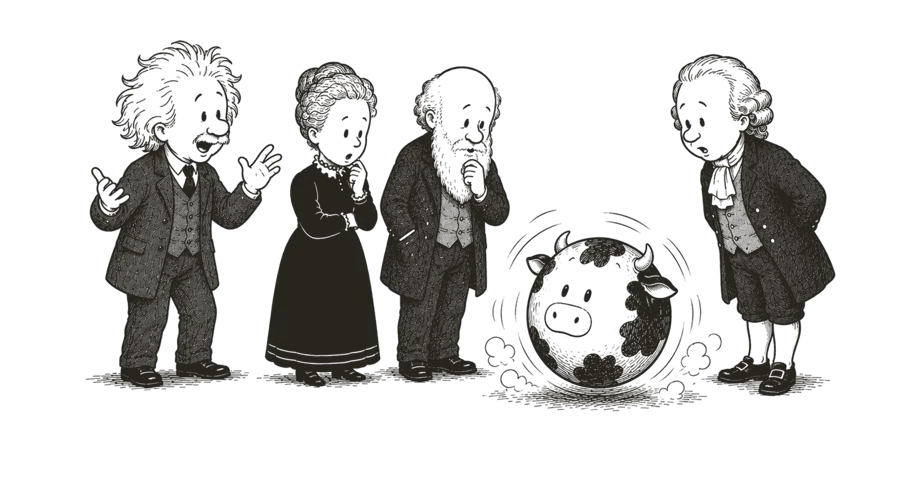
The cast from the process archive. The cow was already doing a lot of explaining. The joke captures something I love about physics. Simplify an overwhelming phenomenon until an essential mechanism becomes visible. Learn something from that simpler world. Then remember what you left out.
The Yard-Sale model isn't the whole economy. It doesn't contain everyone's talents, institutions, histories, or opportunities. It isn't proof that all real inequality comes from luck. But it shows that some consequences can arise from the mechanics of exchange alone.
I wanted visitors to understand that distinction without enduring a lecture.
- Kept: the physicist's habit of simplifying.
- Let go: the scientists explaining everything.
-
September · Version 4
Blue, Red, and Galileo
The storytelling plan was inspired by Galileo's dialogues. Two characters would discuss the world; the reader would listen to their arguments and make up their own mind.
Blue and Red became my protagonists. One might defend the fairness of the coin. The other might ask why the same square kept getting richer.
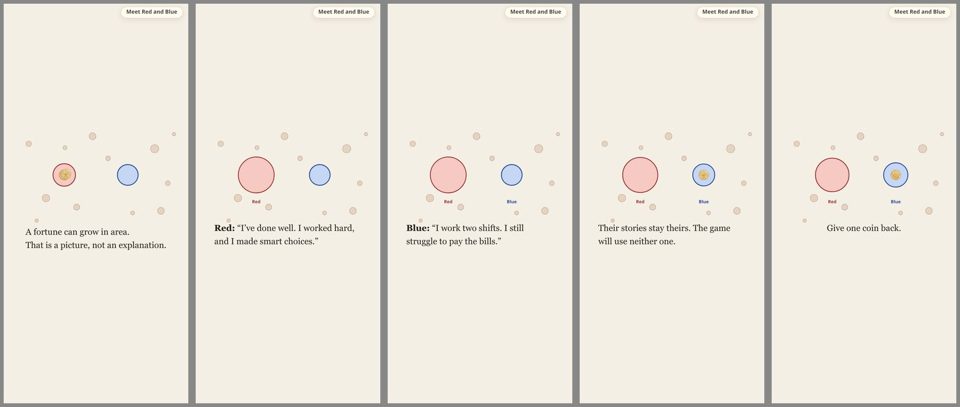
An earlier, much talkier way into the model. I tried different conversations and stories. But the more the characters talked, the more I felt I was giving a lecture. Worse, I was telling people which conclusions to reach.
That wasn't what I wanted. I wanted people to experiment, become surprised, disagree, ask questions, and reach their own conclusions.
I decided to remove the narrator, including myself.
The colours stayed. Most of the talking didn't.- Kept: Blue, Red, and the possibility of questions.
- Let go: the lecture.
-
Early October · Version 5
Little squares with feelings
Although I had abandoned the dialogue, I couldn't abandon the characters. I wanted the squares to have emotions.
I liked Lisa Feldman Barrett's How Emotions Are Made, and I wanted a systematic approach instead of simply drawing a few happy and sad faces.
Amazon Associate: I earn from qualifying purchases.
I experimented with valence and arousal: pleasant or unpleasant, calm or excited. These are the dimensions of James A. Russell's circumplex model of affect, which inspired the characters.
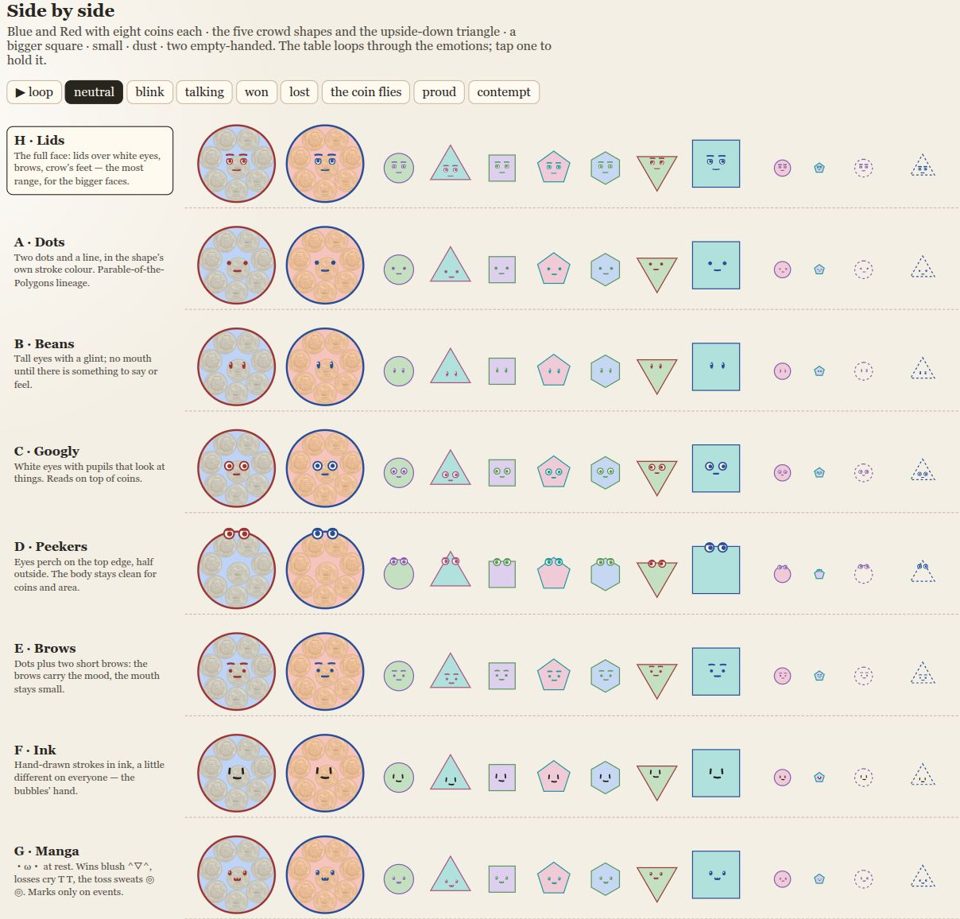
Eight styles. I kept one. The squares could look anxious, excited, furious, delighted, or smug. A tiny face made an enormous difference. Losing half your wealth wasn't merely a numerical operation anymore. Someone looked unhappy about it.
A closer look at the face studio: the same square, several feelings. - Kept: emotional little squares.
- Let go: seven other styles.
-
10 October · Version 6
One room, two dials
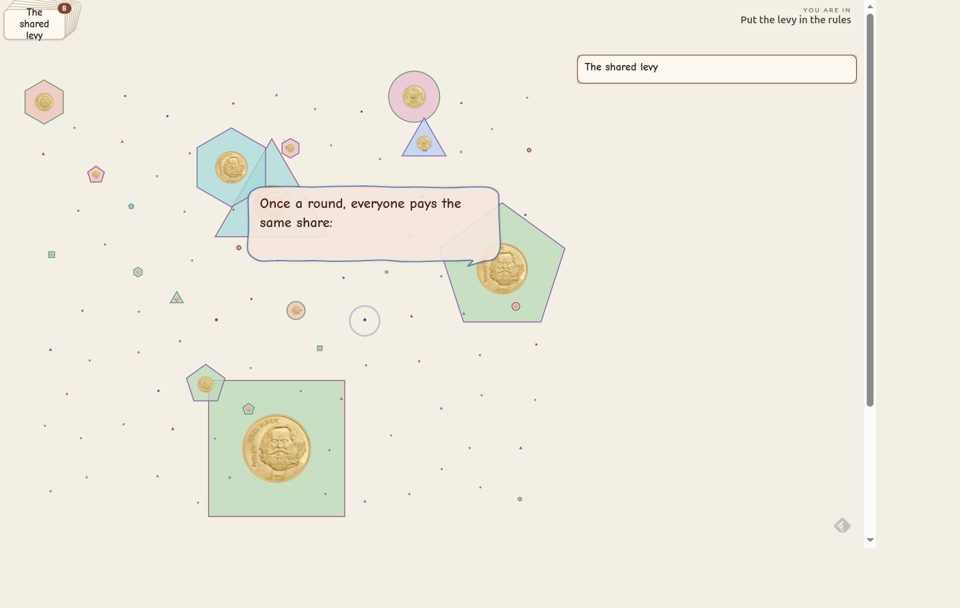
The two-dial prototype. The stake and the tax became two important ways of changing the world. Marx flips a coin
During development, I found something irresistible: a gold coin bearing Karl Marx's face.
A Marx coin determining who gets richer through a fair coin toss in a wealth inequality simulation. I couldn't resist the joke. It became the coin that decides the outcome of a trade.
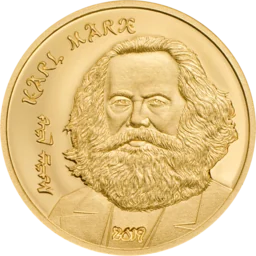

The actual coin images used by the game. CIT's Revolutionaries series: the reference page shows the silver edition and describes its matching gold companion. Build your own world
The Yard-Sale model is only one of many simple models with interesting collective behaviour. I started thinking: why stop at one? What if people could change the rules themselves?
That led to a Blockly-based interface in which rules become blocks that people arrange and modify. Instead of merely watching my experiment, visitors could build their own.
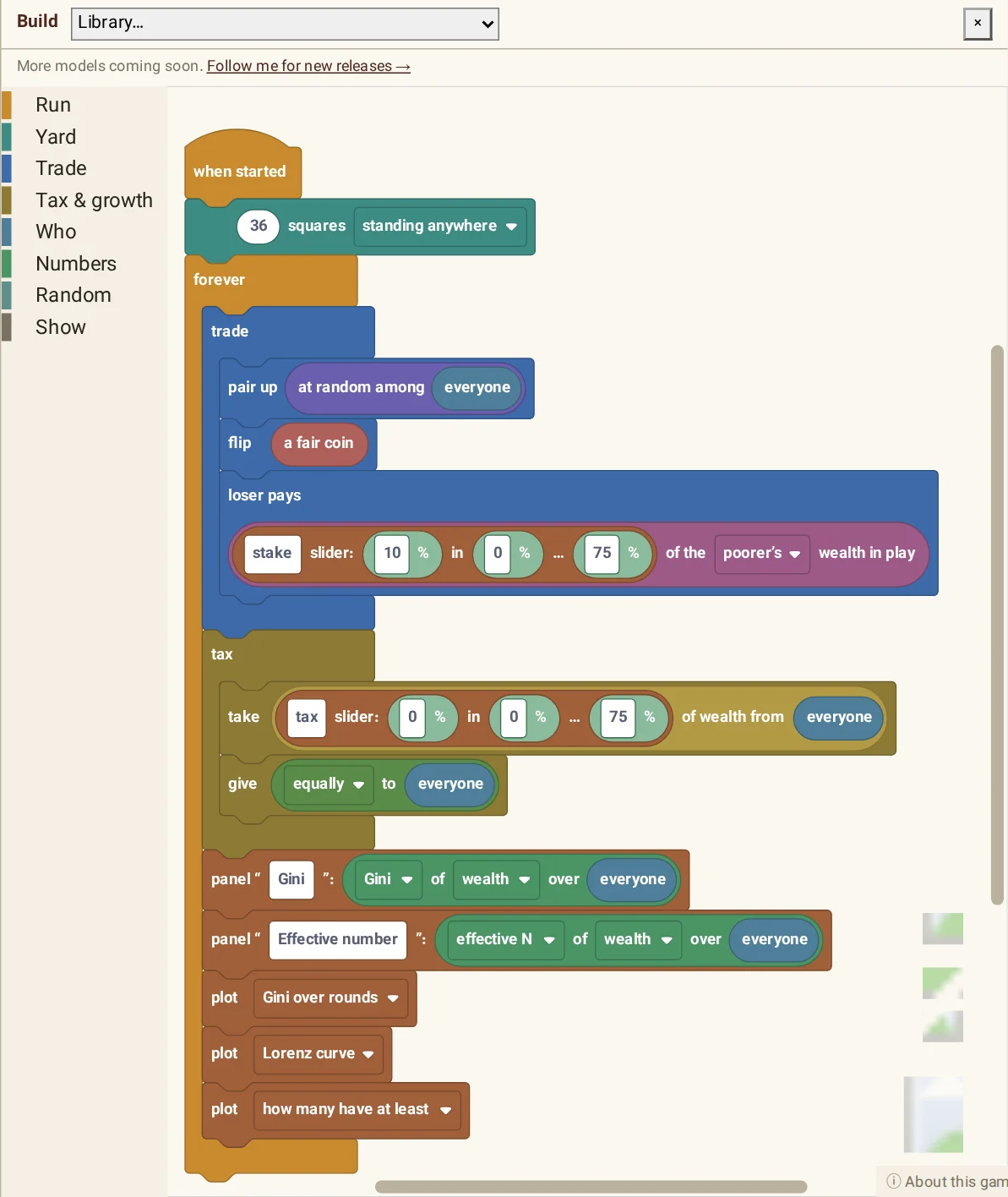
The trading and redistribution rules, inside the current editor. Changing the stake and the tax can produce very different worlds. And that made another philosophical question suddenly practical.
Be Born The veil of ignorance
One of my favourite ideas in political philosophy comes from John Rawls. Imagine choosing the rules of society without knowing who you'll be within it.
Rich or poor. Powerful or powerless. Lucky or unlucky.
This is the veil of ignorance. It inspired the Be born button.
First, build a world with the rules you prefer. Then be born into it as a randomly chosen participant.
Would you still choose the same rules?

In the real game, change the stake or tax, let it trade, then choose Be born in the control bar. This is a random place in a model, not a simulation of a whole human life.
Or open the yard in a full window →- Kept: the dials, the coin, and the freedom to change the rules.
- Let go: the idea that I had to choose everyone's experiment for them.
-
18 October · Version 7
Fair and Square
Once I chose squares, the name practically chose itself. In English, fair and square means honestly and fairly. My game was about fairness. And the little agents were literally squares.
That pun was too good to pass up.
I kept simplifying. No long lectures. No narrator. No charts disconnected from the world they describe. Just a coin, some squares, a few rules, and statistical pictures made of the squares themselves.
The current game. The yard does the telling. Everyone starts equal.
Every trade is fair.
What happens next?- Kept: the question, and room to find your own answer.
- Let go: the narrator.
Why I couldn't stop
About ten years ago, I translated Nicky Case's The Evolution of Trust into Persian. It became unexpectedly popular. People shared it, wrote about it, and made videos about it.
I still think it may be one of the most useful things I've done. I wanted to create an original explorable of my own.
And there was something personal about the timing. Sometimes life becomes difficult enough that creating something feels like the only thing that makes sense.
Not to build a résumé, optimise a LinkedIn profile, or follow a career plan. Not even because I know it will make money. Simply because I want this thing to exist.
I spent months immersed in this little world: experimenting, rewriting, discarding, and starting again. Sometimes I forgot about everything else. Including people who deserved more of my attention.
I owe my family quite a lot for these months. At the very least, a proper coffee for my wife and me, and three hot chocolates for the children.
Perhaps a lot more.
Not everything I tried worked. Not everything I removed was a mistake. And some of those abandoned ideas may return in another little world.